Instagram

Translate

Thursday, February 02, 2012

Australia -- land of the koala, kangaroo... and elephant

Elephants and maybe rhinoceroses could be introduced to Australia to chomp on an invasive African grass that also causes wildfires, according to an idea reported in a scientific journal on Wednesday.

"A major source of fuel for wildfires in the monsoon tropics is gamba grass, a giant African grass that has invaded north Australia's savannas," said David Bowman, a professor of environmental change biology at the University of Tasmania.

"It is too big for marsupial grazers (kangaroos) and for cattle and buffalo, the largest feral mammals. But gamba grass is a great meal for elephants or rhinoceroses."

Bowman, writing in the prestigious British journal Nature, admitted that introducing wild elephants to Australia "may seem absurd."

"But the only other methods likely to control gamba grass involve using chemicals or physically clearing the land, which would destroy the habitat," he said.

"Using mega-herbivores may ultimately be more practical and cost-effective, and it would help to conserve animals that are threatened by poaching in their native environments."

Bowman noted the destruction of other species that have been introduced to Australia and stressed that if the tusker were introduced Downunder, the move would have to proceed very cautiously.

Biologists would have to monitor the effect on the ecoystem and numbers would have to be controlled to prevent over-breeding.

LETTER FROM MARK ZUCKERBERG via Time Magazine


Facebook was not originally created to be a company. It was built to accomplish a social mission — to make the world more open and connected.
We think it's important that everyone who invests in Facebook understands what this mission means to us, how we make decisions and why we do the things we do. I will try to outline our approach in this letter.
At Facebook, we're inspired by technologies that have revolutionized how people spread and consume information. We often talk about inventions like the printing press and the television — by simply making communication more efficient, they led to a complete transformation of many important parts of society. They gave more people a voice. They encouraged progress. They changed the way society was organized. They brought us closer together.
Today, our society has reached another tipping point. We live at a moment when the majority of people in the world have access to the internet or mobile phones — the raw tools necessary to start sharing what they're thinking, feeling and doing with whomever they want. Facebook aspires to build the services that give people the power to share and help them once again transform many of our core institutions and industries.
There is a huge need and a huge opportunity to get everyone in the world connected, to give everyone a voice and to help transform society for the future. The scale of the technology and infrastructure that must be built is unprecedented, and we believe this is the most important problem we can focus on.
We hope to strengthen how people relate to each other.
Even if our mission sounds big, it starts small — with the relationship between two people.
Personal relationships are the fundamental unit of our society. Relationships are how we discover new ideas, understand our world and ultimately derive long-term happiness.
At Facebook, we build tools to help people connect with the people they want and share what they want, and by doing this we are extending people's capacity to build and maintain relationships.
People sharing more — even if just with their close friends or families — creates a more open culture and leads to a better understanding of the lives and perspectives of others. We believe that this creates a greater number of stronger relationships between people, and that it helps people get exposed to a greater number of diverse perspectives.
By helping people form these connections, we hope to rewire the way people spread and consume information. We think the world's information infrastructure should resemble the social graph — a network built from the bottom up or peer-to-peer, rather than the monolithic, top-down structure that has existed to date. We also believe that giving people control over what they share is a fundamental principle of this rewiring.
We have already helped more than 800 million people map out more than 100 billion connections so far, and our goal is to help this rewiring accelerate.
We hope to improve how people connect to businesses and the economy.
We think a more open and connected world will help create a stronger economy with more authentic businesses that build better products and services.
As people share more, they have access to more opinions from the people they trust about the products and services they use. This makes it easier to discover the best products and improve the quality and efficiency of their lives.
One result of making it easier to find better products is that businesses will be rewarded for building better products — ones that are personalized and designed around people. We have found that products that are "social by design" tend to be more engaging than their traditional counterparts, and we look forward to seeing more of the world's products move in this direction.
Our developer platform has already enabled hundreds of thousands of businesses to build higher-quality and more social products. We have seen disruptive new approaches in industries like games, music and news, and we expect to see similar disruption in more industries by new approaches that are social by design.
In addition to building better products, a more open world will also encourage businesses to engage with their customers directly and authentically. More than four million businesses have Pages on Facebook that they use to have a dialogue with their customers. We expect this trend to grow as well.
We hope to change how people relate to their governments and social institutions.
We believe building tools to help people share can bring a more honest and transparent dialogue around government that could lead to more direct empowerment of people, more accountability for officials and better solutions to some of the biggest problems of our time.
By giving people the power to share, we are starting to see people make their voices heard on a different scale from what has historically been possible. These voices will increase in number and volume. They cannot be ignored. Over time, we expect governments will become more responsive to issues and concerns raised directly by all their people rather than through intermediaries controlled by a select few.
Through this process, we believe that leaders will emerge across all countries who are pro-internet and fight for the rights of their people, including the right to share what they want and the right to access all information that people want to share with them.
Finally, as more of the economy moves towards higher-quality products that are personalized, we also expect to see the emergence of new services that are social by design to address the large worldwide problems we face in job creation, education and health care. We look forward to doing what we can to help this progress.
Our Mission and Our Business
As I said above, Facebook was not originally founded to be a company. We've always cared primarily about our social mission, the services we're building and the people who use them. This is a different approach for a public company to take, so I want to explain why I think it works.
I started off by writing the first version of Facebook myself because it was something I wanted to exist. Since then, most of the ideas and code that have gone into Facebook have come from the great people we've attracted to our team.
Most great people care primarily about building and being a part of great things, but they also want to make money. Through the process of building a team — and also building a developer community, advertising market and investor base — I've developed a deep appreciation for how building a strong company with a strong economic engine and strong growth can be the best way to align many people to solve important problems.
Simply put: we don't build services to make money; we make money to build better services.
And we think this is a good way to build something. These days I think more and more people want to use services from companies that believe in something beyond simply maximizing profits.
By focusing on our mission and building great services, we believe we will create the most value for our shareholders and partners over the long term — and this in turn will enable us to keep attracting the best people and building more great services. We don't wake up in the morning with the primary goal of making money, but we understand that the best way to achieve our mission is to build a strong and valuable company.
This is how we think about our IPO as well. We're going public for our employees and our investors. We made a commitment to them when we gave them equity that we'd work hard to make it worth a lot and make it liquid, and this IPO is fulfilling our commitment. As we become a public company, we're making a similar commitment to our new investors and we will work just as hard to fulfill it.
The Hacker Way
As part of building a strong company, we work hard at making Facebook the best place for great people to have a big impact on the world and learn from other great people. We have cultivated a unique culture and management approach that we call the Hacker Way.
The word "hacker" has an unfairly negative connotation from being portrayed in the media as people who break into computers. In reality, hacking just means building something quickly or testing the boundaries of what can be done. Like most things, it can be used for good or bad, but the vast majority of hackers I've met tend to be idealistic people who want to have a positive impact on the world.
The Hacker Way is an approach to building that involves continuous improvement and iteration. Hackers believe that something can always be better, and that nothing is ever complete. They just have to go fix it — often in the face of people who say it's impossible or are content with the status quo.
Hackers try to build the best services over the long term by quickly releasing and learning from smaller iterations rather than trying to get everything right all at once. To support this, we have built a testing framework that at any given time can try out thousands of versions of Facebook. We have the words "Done is better than perfect" painted on our walls to remind ourselves to always keep shipping.
Hacking is also an inherently hands-on and active discipline. Instead of debating for days whether a new idea is possible or what the best way to build something is, hackers would rather just prototype something and see what works. There's a hacker mantra that you'll hear a lot around Facebook offices: "Code wins arguments."
Hacker culture is also extremely open and meritocratic. Hackers believe that the best idea and implementation should always win — not the person who is best at lobbying for an idea or the person who manages the most people.
To encourage this approach, every few months we have a hackathon, where everyone builds prototypes for new ideas they have. At the end, the whole team gets together and looks at everything that has been built. Many of our most successful products came out of hackathons, including Timeline, chat, video, our mobile development framework and some of our most important infrastructure like the HipHop compiler.
To make sure all our engineers share this approach, we require all new engineers — even managers whose primary job will not be to write code — to go through a program called Bootcamp where they learn our codebase, our tools and our approach. There are a lot of folks in the industry who manage engineers and don't want to code themselves, but the type of hands-on people we're looking for are willing and able to go through Bootcamp.
The examples above all relate to engineering, but we have distilled these principles into five core values for how we run Facebook:
Focus on Impact
If we want to have the biggest impact, the best way to do this is to make sure we always focus on solving the most important problems. It sounds simple, but we think most companies do this poorly and waste a lot of time. We expect everyone at Facebook to be good at finding the biggest problems to work on.
Move Fast
Moving fast enables us to build more things and learn faster. However, as most companies grow, they slow down too much because they're more afraid of making mistakes than they are of losing opportunities by moving too slowly. We have a saying: "Move fast and break things." The idea is that if you never break anything, you're probably not moving fast enough.
Be Bold
Building great things means taking risks. This can be scary and prevents most companies from doing the bold things they should. However, in a world that's changing so quickly, you're guaranteed to fail if you don't take any risks. We have another saying: "The riskiest thing is to take no risks." We encourage everyone to make bold decisions, even if that means being wrong some of the time.
Be Open
We believe that a more open world is a better world because people with more information can make better decisions and have a greater impact. That goes for running our company as well. We work hard to make sure everyone at Facebook has access to as much information as possible about every part of the company so they can make the best decisions and have the greatest impact.
Build Social Value
Once again, Facebook exists to make the world more open and connected, and not just to build a company. We expect everyone at Facebook to focus every day on how to build real value for the world in everything they do.
Thanks for taking the time to read this letter. We believe that we have an opportunity to have an important impact on the world and build a lasting company in the process. I look forward to building something great together


Facebook IPO

Wednesday, February 01, 2012

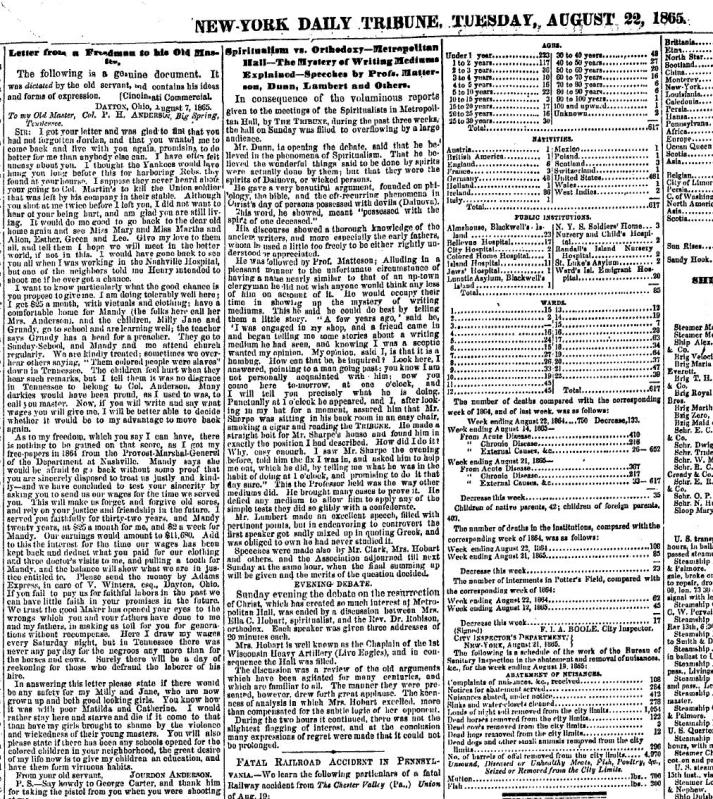
Jourdan Anderson's letter to his former master in 1865

In August of 1865, a Colonel P.H. Anderson of Big Spring, Tennessee, wrote to his former slave, Jourdan Anderson, and requested that he come back to work on his farm. Jourdan — who, since being emancipated, had moved to Ohio, found paid work, and was now supporting his family — responded spectacularly by way of the letter seen below (a letter which, according to newspapers at the time, he dictated).

Rather than quote the numerous highlights in this letter, I'll simply leave you to enjoy it. Do make sure you read to the end.

(Source: The Freedmen's Book; Image: A group of escaped slaves in Virginia in 1862, courtesy of the Library of Congress.)

Dayton, Ohio,

August 7, 1865

To My Old Master, Colonel P.H. Anderson, Big Spring, Tennessee

Sir: I got your letter, and was glad to find that you had not forgotten Jourdon, and that you wanted me to come back and live with you again, promising to do better for me than anybody else can. I have often felt uneasy about you. I thought the Yankees would have hung you long before this, for harboring Rebs they found at your house. I suppose they never heard about your going to Colonel Martin's to kill the Union soldier that was left by his company in their stable. Although you shot at me twice before I left you, I did not want to hear of your being hurt, and am glad you are still living. It would do me good to go back to the dear old home again, and see Miss Mary and Miss Martha and Allen, Esther, Green, and Lee. Give my love to them all, and tell them I hope we will meet in the better world, if not in this. I would have gone back to see you all when I was working in the Nashville Hospital, but one of the neighbors told me that Henry intended to shoot me if he ever got a chance.

I want to know particularly what the good chance is you propose to give me. I am doing tolerably well here. I get twenty-five dollars a month, with victuals and clothing; have a comfortable home for Mandy,—the folks call her Mrs. Anderson,—and the children—Milly, Jane, and Grundy—go to school and are learning well. The teacher says Grundy has a head for a preacher. They go to Sunday school, and Mandy and me attend church regularly. We are kindly treated. Sometimes we overhear others saying, "Them colored people were slaves" down in Tennessee. The children feel hurt when they hear such remarks; but I tell them it was no disgrace in Tennessee to belong to Colonel Anderson. Many darkeys would have been proud, as I used to be, to call you master. Now if you will write and say what wages you will give me, I will be better able to decide whether it would be to my advantage to move back again.

As to my freedom, which you say I can have, there is nothing to be gained on that score, as I got my free papers in 1864 from the Provost-Marshal-General of the Department of Nashville. Mandy says she would be afraid to go back without some proof that you were disposed to treat us justly and kindly; and we have concluded to test your sincerity by asking you to send us our wages for the time we served you. This will make us forget and forgive old scores, and rely on your justice and friendship in the future. I served you faithfully for thirty-two years, and Mandy twenty years. At twenty-five dollars a month for me, and two dollars a week for Mandy, our earnings would amount to eleven thousand six hundred and eighty dollars. Add to this the interest for the time our wages have been kept back, and deduct what you paid for our clothing, and three doctor's visits to me, and pulling a tooth for Mandy, and the balance will show what we are in justice entitled to. Please send the money by Adams's Express, in care of V. Winters, Esq., Dayton, Ohio. If you fail to pay us for faithful labors in the past, we can have little faith in your promises in the future. We trust the good Maker has opened your eyes to the wrongs which you and your fathers have done to me and my fathers, in making us toil for you for generations without recompense. Here I draw my wages every Saturday night; but in Tennessee there was never any pay-day for the negroes any more than for the horses and cows. Surely there will be a day of reckoning for those who defraud the laborer of his hire.

In answering this letter, please state if there would be any safety for my Milly and Jane, who are now grown up, and both good-looking girls. You know how it was with poor Matilda and Catherine. I would rather stay here and starve—and die, if it come to that—than have my girls brought to shame by the violence and wickedness of their young masters. You will also please state if there has been any schools opened for the colored children in your neighborhood. The great desire of my life now is to give my children an education, and have them form virtuous habits.

Say howdy to George Carter, and thank him for taking the pistol from you when you were shooting at me.

From your old servant,

Jourdon Anderson.

Tuesday, January 31, 2012

Jake Reilly's 'Amish Project:' 90 Days Without a Cell Phone, Email and Social Media

After reading this article below, I am interested in copying his project. But, I am afraid I will not be able to oblige with the rules of Reilly, However, I am curious to see how will be my life without email and social media for 90 days.... ?

source : Yahoo News here

College Student Drops Social Media, Reconnects with Romance

Could you live without daily electronic conveniences -- Twitter, Facebook, email, texting and more -- for 90 days? Jake P. Reilly, a 24-year-old copywriting student at the Chicago Portfolio School, did just that.
From October to December, he unplugged from social media, email, texts, and cell phones because he felt that we spend more quality time with gadgets and keyboards than we do with the people we really care about.
During his social experiment, he found that some people he counted among his close friends really weren't that close after all. He also discovered that taking a break from his relationship with social media and really paying attention to the people around him can revive real-life romance.
I spoke with Reilly over the phone this weekend about his 90-day project, what he learned from living without electronic leashes and how it changed his life.
You say you spent three months completely cut-off from the virtual world. What steps did you take to do that?
Reilly: I called Verizon and suspended service for my cell phone. I deactivated Facebook. I deactivated Twitter, deactivated Linked-In, deactivated Spotify, and anything where there was a social component. I put up an out-of-office on both of my email accounts, like, "I'm sorry for the inconvenience, but I won't receive this until the end of the year."
Did you ever cheat and check to see what messages came in?
Reilly: I never went back on any of the social stuff. There were a few times when the bank would send me an email verification. My roommates would see me checking something like that, and they'd see me with my hands up to shield my eyes from the bulk of the screen, like a girl would do when she's watching a horror movie that she doesn't want to see. I genuinely didn't want to see what was there, because once you look you've got an urge to read it.
Before what you called "The Amish Project," how much time would you typically spend on social media sites, texting, and so forth every day?
Reilly: It was pretty bad. I was reading every single Tweet and I follow 250 people. Then, I would waste a good hour and a half on Facebook. I was sending more than 1,500 texts a month. I never really counted minutes on the phone, but I wouldn't be surprised if it was 600 to 900.
What about now, has it changed?
Reilly: I mean, I struggle with that because everyone wants to know about it, and wants to know how different it is. It's hard, because I was just going to turn off my phone at first. That was the thing that bothered me most, but I realized that if I turned off the phone, people were just going to email me all the time or send me a million Facebook messages. It's kind of a hard thing, because we're getting to the point where if you're not responding to people's text messages within an hour of when they send them, or within a day for emails, it's just socially unacceptable. It's been hard for me since I've been back. I've been bad with my phone and people are, like, "What the hell? I text messaged you…" So I haven't been up to social standards in terms of responding and people don't really understand that, I guess.
In the opening of your "Going Amish" presentation, you say that you had friends over and realized what was going on. Describe what you noticed and your feelings right at that moment.
Reilly: I live with three guys and we had two of our best friends in visiting from New York City. We only see these guys once a year, maybe every six months. We were at the University of Wisconsin watching a Badgers basketball game or something like that. Every single person had either a laptop or a cell phone. That's just kind of funny to begin with, then, I was like, "What are we all doing?" I asked everyone what they were doing and somebody's playing Words with Friends, somebody's playing Angry Birds, somebody's playing online trivia. Nobody's really doing anything, just sitting quiet. It's like this was what we were all looking forward to and we're just sitting here numbing our minds.
That's the thing that drives me crazy. People go out to dinner with a crowd and everyone's on their phone. I mean, what else are you looking for?
How did you communicate with family, friends and business associates during your "Amish" period?
Reilly: Ha! Not well, to say the least.
Do you have a landline?
Reilly: At first, we didn't, but my mom started freaking out a little bit and we got a landline. For the first three weeks, there was a hospital right next to my apartment. I went into their waiting room where there's a courtesy phone for their patients. I was using that to call people. I had written a little address book with all the important people that I needed to have their phone numbers, but, you know, most people don't answer their phones. Most people just use them to see who called. Then, they'll text you, or they'll call you back when they have time. So, I'd either sit at the hospital waiting for people to call back or I'd go home. I was in and out of this stupid hospital waiting room all the time for the first couple of weeks.
Then, we started to have more fun with it. I started to carry chalk around with me. I ride my bike a lot, so, I'd ride my bike over to people's houses and leave them messages in chalk on their sidewalk. I set up a couple of systems with people where, when they got home, they would put something in the window, like a stuffed dog, or put a pumpkin up on the ledge that meant "Hey, I'm here. Come talk." I started having fun trying to dream up different ways to get people's attention.
Were there people who said, "I'm just not going to participate in this. If you can't answer my texts, I don't need to talk to you."
Reilly: Yeah, I mean, I definitely just lost complete contact with people that normally would have been part of my life. I mean it's also an interesting metric for your life to see who some of your closest friends are, you know, and who's willing to take the time. I started to feel bad for them, too, because it definitely became a nuisance, but, yeah, it definitely changed the level of, or the number of friends that I had and the level of contact that I had with them.
So, with some people it clearly decreased your level of interaction, but were there others with whom your contact increased in either quality or quantity while you were disconnected from the virtual social society?
Reilly: That was my other favorite part. I had so much free time on my hands. I also wasn't watching TV, because that felt sort of counter-productive. I would go to school, and then there was really nothing for me to do at home, so I would just ride my bike to people's houses, all these people that I would usually text or just see on the weekends or whatever. I would just ride by and chat with them, face to face. So, that was really cool, reconnecting, doing things you'd never normally do like having breakfast with someone's parents.
You posted several of the notes you received from friends during your isolation. One note read "Jake, I'm pregnant. Call me." What was that about?
Reilly: Ha! At the school, there's an elevator. No matter where you're going, everyone has to use the elevator on the ground floor. So, for the people that I went to school with, that was the first place we'd post projects or memes. I didn't say this is my message board, but one of the girls just started leaving messages, like, "Hey. I'm on the fourth floor. Come find me," or "Jake, where are you?" It's a very public forum, so everybody can read it. It became my message spot.
Then, people almost treated it like a Facebook wall. It evolved from leaving messages for each other, to joking around, like, "Jake, your mother called. She said she doesn't love you anymore," and "Jake, the cops are looking for you," and all this stuff. It turned into a funny thing.
At one point there was a Christmas greeting trampled in the snow? What were the circumstances around that?
Reilly: Yeah, that was mine for my long-term girlfriend who I had kind of stopped seeing, but then this whole thing kind of, I think, helped us get back together because whenever we were together there was no pressure. It was, OK, we're just going to enjoy each other right now, because I don't know when I'm going to see you again. There was no drunken text messaging and jealousy from Facebook. It was just her and I.
So we started seeing each other again, and I did a lot of cheesy stuff like writing a big chalk message on the street in front of her office building and sending her a cookie with a message written in frosting and stuff like that. On the last week that she was in Colorado I went out and wrote Merry Christmas to her -- that picture was taken from the roof of the apartment we were staying at.
Do you think that those who rely so heavily on social media to interact with others are training themselves to communicate only at the most superficial level?
Reilly: Yeah, for sure. I think that Facebook is the biggest waste of time, because everyone is just presenting such a filtered picture of themselves. You only put up your best pictures. People only check in when they are at the fanciest restaurant in the city. They only keep things up there that are flattering to themselves. I just think it's like keeping up with the Joneses, but for life. You're never going to get on top of it. Someone's always going to have a better job than you, go on better vacations than you, have a better looking wife than you, or whatever it is. So, it's superficiality on top of superficiality. You never get to see the real parts of people.
Did you have to relearn skills to function without electronic communications? Writing letters, for example. I know my son has nearly illegible penmanship because he has been typing everything instead of handwriting since he was very little.
Reilly: I really don't have good penmanship at all. The funny thing is that I had written like 15 or 20 letters, and I just held them for two weeks until one time I dropped my pack and realized that I had lost the letters. I had taken all the time to write the letters and then lost them, because I didn't take the time to go mail them. You know, when's the last time I sent a letter? Never. So, I had to remember to stamp it right away and get it in. Then, it's going to take a week to get there. So when you need to say something to someone, you need to get it right in on time.
You said that you had much more free time when you stayed off Facebook and social media sites. Did this extra time translate into higher productivity or better grades at school?
Reilly: Yeah, a hundred times over. Like I said, there wasn't really much to do at the house, so I stayed at school most nights until 10 when everyone else leaves around 6, without a doubt. I think what's so hard for people and so distracting for people is that where they work, there are social media distractions on the same machine that they are supposed to be using to do their work. I'm sure every office in the country suffers from these things. I couldn't go to these sites, and when you can't distract yourself, all you can do is work.
How did you fill all this extra time? What's one thing you would have never accomplished if you hadn't taken this break in your relationship with social media?
Reilly: I did a lot of things that I don't know […] other people would say they want to do. But I think, if they actually did them, they'd be of incredible value. I started meditating. People give you a lot of books that you can take time for, like "The Power of Now."
The best part for me was just the difference between riding your bike to work and going for a bike ride just for the fun of it. I would sit in the park a lot, throw the football with my friends, go ice-skating, and all that kind of silly stuff that you take for granted. It's all around you. I think that was the best part and most people really overlook that.
So you ended up not only with more time for work, but more time for play as well.
Reilly: Yes, absolutely. It was weird, because you had to think of how to play. Most people think more time for play means let's watch a whole series of video clips or tag some pictures, but when you don't have all that stuff, you expand your mind about what you want to do with your free time.
There's a real difference in the quality of that time. If I sit and play Angry Birds for an hour a day, I don't look back and say "You know, I had a really great Angry Birds session three weeks ago. That was a really great time," but if I share a sunset walk on the beach with someone, that's a memory that I can treasure forever.
Reilly: Yeah, sometimes you just sit on the internet and four hours goes by, and you're, like, I really didn't do one single thing. Maybe I looked at an article, looked at pictures, watched some dumb videos and got stuck in a YouTube black hole for an hour, just looking, looking, looking. I think you'd have a hard time finding anyone who thought that was really enriching your life.
I mentioned your story to my father-in-law the other day, he said "You want to interview somebody, talk to me. I've been doing that for 69 years!"
Reilly: Ha! I think that's what's so much fun about it. I've had a lot of action on Twitter for the last few days and a lot of people send me emails saying exactly that. I think adults really relate to it and think it's cool that someone from my generation is choosing to do it. They all say, "That's how we lived for 40 years. Can you imagine our whole life is like that?" That was interesting to me. I asked my grandparents, "How did you guys find each other when you wanted to go out or something?" They said stuff like throwing window pebbles and just driving by people's houses, and having a diner that you would go and turn up at where people were always there. I mean, they obviously managed just fine, and I was anxious about it and didn't like it for the first few weeks. Then, I didn't even think about my phone or miss it at all. You just find new ways.
I understand your father, ESPN sportswriter Rick Reilly, had a suggestion about your experience?
Reilly: Yeah, he's tweeted it out on his account and he's gotten a lot of reaction to it, too. He's been talking about trying to do a romantic comedy about it. There were so many missed connections. I mean, at first, I would meet girls out at the bar, and they'd be, like, "Here, take my phone number." I would have to explain that I didn't have an email address or Facebook…
…but if they'll give you their address you'll stop by sometime?
Reilly: Yeah, and they were, like, "Screw you. If you don't want to call me just say so." I'd say "No, no. Tell me where your office is, and I'll send you a bike courier message or whatever." I think there's a lot of funny stuff like that. I keep telling people the hardest part was having to send all of my sexts by USPS. I mean, I didn't actually send pictures…
In the end, having finished this whole thing, is your life different now or did you fall right back into old habits?
Reilly: It's definitely different, but I catch myself doing exactly what I hated. Someone is talking to me and I'm half-listening and reading a text under the table. For me, it's trying to be more aware of it. It kind of evolved from being about technology to more of just living in the moment. I think that's what my biggest thing is: There's not so much chasing for me now. I'm here now, and let's just enjoy this. You can be comfortable with yourself and not have to go to the crutch of your phone. For me, that's more what I will take away from this.
Do you have future projects planned?
Reilly: I keep telling everyone I should do another 90 days where I don't speak to anyone in person and only communicate by internet or through technology, but that's just a joke. It's really changed my life. Like I said, I'm back with this girl. Everything's a lot simpler. I'm more than happy that I did it.
What else did you learn?
Reilly: I think the letters were the coolest part and how people were really into it. I think I wrote 75 letters and nearly, I'd say, 85 percent came back with responses. Now all these people are responding to the video online. All the appreciation, I think the coolest part is that all these people really see this in themselves and wish that there was a different way and we weren't so tied to all that stuff.
Let me ask you one more question about the letters. What's the difference in the level of thought and feeling that you put into writing a letter compared to typing 140 characters?
Reilly: What we do now, on e-chat, is people just flying off with whatever comes to mind. It's so much different to have it really thought-out. I'm a writer, so it's time consuming. I think it takes 20 minutes or half an hour to write a letter and really get it the way I want it. I think it's a better, purer way to communicate. People appreciate it so much more when you send them a handwritten letter or even a thank-you note showing that you're taking the time to think about them.
Conclusion
With modern technology, texts and Facebook wall posts can serve as an attractive veneer making relationships seem more genuine than they really are. Conversely, social media can interfere with our most intimate real-life relationships. How many of your closest relationships would suffer if people had to invest more effort than sending a text to stay in touch? How much better could your relationship with your significant other be if you could give your partner your full attention whenever you're together? There's one way to find out, if you dare.
To see more of Reilly's work, go to BodyCopyByJake.com.